


Roof tarp guide: everything you need to know to effectively protect your roof
By Bâches Direct
Published on 16-02-2026
Last updated 19-03-2026
4


A damaged roof, an ongoing renovation or an unexpected leak? The roof tarp is the essential rampart to protect the building against water infiltration and bad weather. Whether you are an individual looking for an emergency solution or a professional roofer managing several projects, choosing the right roof covering is crucial.
Which roof tarp to choose to protect my roof?
- For an emergency or a short construction site (a few weeks): HDPE (High Density Polyethylene) roofing tarpaulins are an excellent choice. HDPE roof tarps are light and strong, economical and 100% waterproof. All our HDPE tarpaulins are available in stock for ultra-fast delivery.
- For long-term protection or heavy renovation (several months or years): Choose a PVC roof tarp for effective protection in the medium to long term. Our PVC tarpaulins are resistant, 100% waterproof with a commercial warranty of 5 to 15 years depending on the model.
- For building professionals: We offer batches of roofing tarpaulins (from 2 to 40 units) allowing you to pool your costs and manage several sites simultaneously with always available stock.
HDPE or PVC: Which material to choose for an effective roof tarp?
The choice of material depends on the expected duration of exposure and the complexity of your framework.
The HDPE roof tarp: an excellent value for money
The Tecplast HDPE roof tarp is an ally in critical or emergency situations. Its lightness allows easy handling, even on large surfaces.
- The advantages: Unbeatable price, total waterproofing and a very wide range of formats to cover all surfaces.
- The most Bâches Direct: Our batches of 2 to 40 units are designed to meet both the need for domestic troubleshooting and the complete equipment of a coverage company.
-

GOOD DEAL
Roofing
Roof tarpaulin 5x8 m - TECPLAST - HQ250TO - Green and Brown - High Performance - Waterproofing tarpaulin for Roofers and Carpenters
(882)€64.97
-10% off with code SUN
-

GOOD DEAL
Roofing
Roof tarpaulin 8x12 m - TECPLAST - HQ250TO - Green and Brown - High Performance - Waterproofing tarpaulin for Roofers and Carpenters
(882)€141.98
-10% off with code SUN
-

-7%
GOOD DEAL
Roofing
ESSENTIAL Roofer Pack - 2 Waterproof tarpaulins TECPLAST HQ250TO - 6x10m (x1) + 5x8m (x1) - Green and Brown - PM6TO
(1)€144.85
€154.96
-10% off with code SUN
-

-8%
GOOD DEAL
Roofing
COMFORT Roofer Pack - 4 Waterproof tarpaulins TECPLAST HQ250TO - 6x8m (x2) + 8x12m (x1) + 4x5m (x1) - Green and Brown - PM7TO
(1)€301.81
€326.92
-10% off with code SUN
-

-9%
GOOD DEAL
Roofing
PROFESSIONAL Roofer Pack - 8 Waterproof tarpaulins TECPLAST HQ250TO - 8x12m (x2) + 6x10m (x2) + 5x8m (x2) + 4x5m (x2) - PM8TO
(1)€601.78
€657.83
-10% off with code SUN
The PVC roof tarp: a more effective protection over time
If your roof must remain bare for several weeks or months, only a PVC roof tarp guarantees effective protection.
- Resistance: Very strong resistance to winds and weather, a PVC tarpaulin is the ideal solution to protect the building from bad weather and climatic hazards.
- Tecplast warranty: Depending on the model, our PVC tarpaulins for roofing are guaranteed up to 15 years depending on the model, transforming a temporary solution into an almost permanent protection.
-

GOOD DEAL
Roofing
Dark Beige Roof Tarpaulin 3x6 m - 5 years Warranty TECPLAST - LP506TO - PVC waterproofing tarpaulin for roofers and carpenters
(30)€151.98
-10% off with code SUN
-

GOOD DEAL
Roofing
Grey Roof Tarpaulin without Eyelets 3x5 m - 10 years Warranty TECPLAST - XP640TO - Waterproof PVC tarp - Made in France
(3)€148.98
-10% off with code SUN
-

GOOD DEAL
Roofing
Ivory Roof Tarpaulin without Eyelets 3x5 m - 10 years Warranty TECPLAST - XP640TO - Waterproof PVC tarp - Made in France
(2)€148.98
-10% off with code SUN
-
GOOD DEAL
Roofing
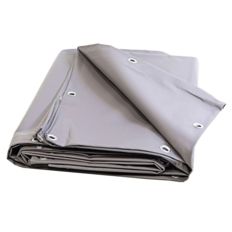
Grey Roof Tarpaulin 3x4 m - 10 years Warranty TECPLAST - XP640TO - Waterproofing tarpaulin for roofers and carpenters - Made in France
(33)€201.98
-10% off with code SUN
Tecplast roofing sheets, a wide range for all needs and surfaces
One of the biggest risks during a tarping is the lack of covering. On a roof, it is vital to provide a safety margin so that water flows without seeping under the tarp.
- Roof tarps - Standard formats: On the online store Baches Direct, we offer more than 50,000 references, in stock in our warehouse in France. For the roofing sheets, we have more than 50 sizes in stock, going up to 20m x 20m, allowing a very fast delivery (essential in case of disaster). We have roofing tarps with eyelets but also tarps by the linear meter (PVC without eyelets), according to the desired fastening method.
- Roof tarps - custom-made: Our catalogue of standard formats is so extensive that it covers 99% of roofing needs, thus ensuring immediate availability. But you also have the possibility to create your custom roof tarp on the online configurator.
Waterproofing: which tarp to choose according to the scope of the work?
Faced with an infiltration or a roofing site, the choice of material should not be rushed. Between the lightness of HDPE for a quick intervention and the robustness of PVC for a water-repellent period of several months, the technical characteristics of a tarpaulin for roofing vary enormously. To help you decide between economy and sustainability, we have synthesized the performance of our Tecplast ranges.
|
Criteria |
HDPE tarpaulin |
PVC tarpaulin |
|---|---|---|
|
Use |
Emergency, short-term protection |
Long construction site, renovation, storage |
|
Sustainability |
From a few months to 2 years depending on the climatic conditions |
Up to 15 years depending on the models |
|
Waterproof |
100% wateproof |
100% wateproof |
|
Weight |
Lightweight (easy handling) |
Medium (maximum stability) |
|
Packaging |
Unit or lots (up to 40 units) |
Unit or customized |
|
Availability |
In stock (Shipping 24/48h) |
In stock or delay for the customer-made |
FAQ - Choosing the best tarp for roofing
The tarping of roofs is a critical operation that requires responding to immediate security and logistics challenges, both for emergency troubleshooting and for large-scale project management. Between the necessary resistance to UV rays and the optimization of costs through the purchase in lots, several criteria determine the success of your waterproofing. Our team has gathered here the answers to essential questions to ensure perfect sealing and efficient stock management.
Which tarp to choose to protect a roof?
The choice depends on the duration of your project. For a temporary need or a small budget, the HDPE (Polyethylene) tarp is ideal because it is light and economical. For a heavy renovation or protection of several months (or even years), turn to the Tecplast PVC tarpaulin. Heavier and more robust, it offers a "truck cover" type of protection capable of withstanding severe climatic conditions.
How long can a tarp remain on a roof?
A standard HDPE roof tarp is designed for periods of weeks to months. For construction sites exceeding the year or in areas highly exposed to wind, we absolutely recommend a PVC roof sheet with much higher resistance to UV rays and tearing.
Why buy batches of tarpaulins rather than individually?
For professionals such as roofers and carpenters, the purchase of batched roofing sheets (up to 40 units of HDPE tarpaulins) reduces the unit cost of a tarpaulin and guarantees immediate reactivity on each new site. For individuals, batches of 2 or 8 for example, allow to ensure a secure covering on complex roofs.
Are the roof tarps UV resistant?
Yes, all our roofing sheets (HDPE and PVC) receive an anti-UV treatment during manufacturing. This prevents the material from becoming brittle under the effect of the sun, ensuring sealing even during scorching summers.
Which roof tarpaulin to use for emergency coverage?
We recommend using a HDPE (High Density Polyethylene) tarp. This material is ideal for emergencies because it is light, which facilitates its handling and quick installation on the roof, while being 100% waterproof. All our HDPE roofing tarps are shipped from our warehouse in France within 48 hours. In case of a disaster, responsiveness is our commitment.
Can I order a custom-made tarpaulin?
Yes, we offer the creation of custom-made PVC roofing sheets to meet specific roof configurations or non-standard dimensions. However, for emergency water stoppage, we always recommend our standard formats (up to 20x20m) which offer immediate protection without manufacturing delays.
What price for a roof tarp?
The price depends on the material and weight. HDPE is very affordable for quick interventions. PVC represents a higher cost than the purchase, but its longevity makes it more economical in the long term. For professionals, we offer lots (up to 40 units) that significantly reduce the unit price and make each site profitable.
What is the lifespan of a roof protection tarp?
Longevity directly depends on the chosen material and exposure to the elements. A standard HDPE tarpaulin has an effective lifespan of 6 to 12 months, which is perfectly suitable for troubleshooting or a short-term project. For heavy renovations or long-lasting protections, our professional PVC tarpaulins are much more robust: they resist UV rays and tears for 10 to 15 years depending on the model. To maximize this lifespan, a perfect tension during installation is essential in order to avoid friction and water pockets.
The safety of your roof begins with the right choice of a tarp for roofing
Protecting a roof is a race against the clock where improvisation has no place. By anticipating your needs, notably thanks to our professional HDPE roof tarps batches, you guarantee the water release of your building in all circumstances.
However, owning the best roof tarp is not enough: its effectiveness will depend above all on the quality of its implementation. A poorly secured tarp or inappropriate tools can reduce your protection efforts. To move from theory to practice and secure your intervention at height, consult our installation guide of good practices for effectively covering a roof.
Technical glossary - Roofing tarps
- Waterproofing: Action to temporarily protect a building from infiltrations (rain, snow) before the final cover is installed or after a disaster.
- HDPE (High Density Polyethylene): Lightweight and economical thermoplastic polymer. It is the reference material for emergency and short-term protective covers.
- Anti-UV Treatment: Chemical process integrated during the manufacture of HDPE or PVC to prevent yellowing, discoloration and loss of flexibility due to sun exposure.
- PVC (Polyvinyl chloride): Heavy and ultra-resistant material used for long-term tarps (projects lasting several months or years).
- Imputrescibilité: Property of a material that cannot be corrupted or rot under the action of moisture, fungi, or bacteria.
Written by the technical team Bâches-Direct, experts in tarpaulins since 2006.
-
5
 Buying guide Pergola PVC
Which cover for a pergola?
Do you want to transform your terrace into a permanent living space? Whether you are looking to cover or dress up a pergola to create a refreshing shaded area or robust protection against the elements, the choice of pergola fabric, or pergola cover , is the central element of your project.
-
4
 Tips Roof
Installation Guide — How to tarp a roof effectively?
To cover a roof, a quality roofing tarp is only truly effective if it is properly installed. A neglected installation can lead to water pockets, devastating wind blows or persistent infiltrations. Whether you are in the renovation phase or in an emergency situation, discover our expert recommendations for a secure and sustainable water disposal.
-
3
 Buying guide Custom made
When should you choose a custom tarp? Tips & examples
It often happens that we look for a 'properly sized' tarp and nothing really fits. A little too short, a little too long... or that floats in the wind. When we want to protect properly, improve the hold and avoid premature wear, the most logical solution often remains the custom tarp.
-
5
 Buying guide
How to choose your tarpaulin?
Find out everything you need to know to choose the right protective tarpaulin! Material, weight, dimensions, use... We guide you step by step in choosing your tarpaulin!
-
2
 Buying guide HDPE
The different uses of the tarpaulin 150 grams
The 150 gram tarp is the versatile tarp. It is useful everywhere, in all environments and all weather. In short, it is the tarp that you must always have at home.
